Showing posts with label How To. Show all posts

Friday, 8 March 2013

White Eagle Medicine Wheel Reading

Recently, I received a new deck, as a gift from a dear family friend: the White Eagle Medicine Wheel deck, by Native American spiritualist Wa-Na-Nee-Che. While I will be writing a piece on the deck itself later on this week, I wanted to share my first reading, using the Four Directions Medicine Wheel layout described in the accompanying book.

For this reading, the cards are laid out as shown below:


Each of the compass points corresponds to a different aspect of life: north pertains to mental attitudes, intelligence and wisdom; east pertains to creativity, ideas and inspiration; south pertains to trust, and to the emotions; and west pertains to the physical and material world. 

At the center of the wheel is the guide card. For this reading, I chose the Badger card. In the White Eagle book, this card is accompanied by the following rhyme:

Badger will organise
Day to day
Live life in order 
Is what it will say

Badger is associated with the gifts of tenacity and appropriate anger, is self-reliant, and can encourage these traits in others. For this reading, he seemed to be the perfect guide.

To read the cards, we first read cards 1-4 of the outer circle, then cards 5-8 of the inner circle. 

The Outer Circle

The first four cards highlight the more negative aspects currently influencing the life of the Querent. They are read anticlockwise, from north to east.

Card One: Otter - The card at the northernmost point of the wheel reflects our own negative attitude. The otter in this position suggests that the Querent is far too rigid with themselves, and needs to step outside of their comfort zone. Otter suggests a reluctance to try new experiences and challenge one's self. When the Otter falls into this position, the message is simple: LIVE A LITTLE!

Card Two: Hawk - The card at the westernmost point of the circle is associated with physical and material difficulties. The Hawk in this position suggests a need to focus on the interior world, on the self. It asks that we look at our health, at our weight and our bad habits, and make the necessary changes in order to move on with life. The Hawk reminds us that a healthy body is needed if one requires a healthy mind.

Card Three: Dog - The card at the southernmost part of the circle relates to trust and the emotions, and to hindrances in this respect. To find the dog here suggests either unreliability on the part of the Querent, or else a sense that one has become too dependent on others. Dog encourages us to stop looking to others for a sense of self worth, reminding us that a healthy attitude toward the self must come from within. Inner stability will translate into stability of relationships with others but also, the reverse is true. Inner instability will also manifest as mistrust and insecurity.

Card Four: Spider - Finally, the easternmost card of the circle pertains to creative blockages, and lack of clarity and inspiration. The Spider in this position suggests that the Querent is trapped, either in a prison of their own making or one of another's design. Either way, the end result is the same - an endless cycle of negative thinking and derivative thought, originality quashed by doubt and restriction.

The Inner Circle

The second set of four cards bring positivity back into focus, drawing our attention to the strengths we have, the opportunities around us, and the areas of life in which we will find our solution. These cards are read clockwise, from north to west.

Card Five: Horse - The northern card of the inner circle reminds us of our own wisdom. It is a great source of mental strength. The Horse in this position suggests an ability to endure suffering, to tolerate hardships and keep on going. A person with the Horse to the inner north is strong, and tenacious.

Card Six: Buffalo - The inner eastern card relates to our source of creativity and clarity. Here we find the Buffalo, which suggests a person who gains inspiration from others, from compassion and sensitivity. The Buffalo in this position reminds us that sometimes when we are lacking in inspiration we need only look to the people around us, that by tuning into them we tune into ourselves.

Card Seven: Elk - The inner card to the south reminds us of the strongest source of laughter, happiness and trust available to us. The Elk is a fitting card to find in this position, as it reminds us of our own ability to love, not just others, but also ourselves. If you find the Elk card in this position during a reading, you have valuable friends around you, and have a stronger support network than you may realise. Take care of others, and take care of yourself - by doing this, you will find that you are never emotionally lacking.

Card Eight: Snake - The card to the west within the inner circle pertains to physical and material balance. Snake in this position immediately suggests a need to rest, and warns against burning out by not taking the time to properly recharge one's batteries. It would seem then that for the Querent to enjoy good physical health, it may be time to take a holiday of some kind, a break from day to day routine. The message here may also be as simple as ensuring that you get enough sleep, if you wish to be at your best. 

Wednesday, 14 September 2011

Sample Zigeuner WahrsageKarten Readings - 13/9/11

Ok, so in this post I touched on the idea that the less specific your cards are (i.e. a deck that does not speak to you, or one with very basic card meanings), the more specific your layouts have to be. So here is a short reading to illustrate the point.
I pulled these three cards for a general feel of things, assigning them very definite meanings:

Card 1= Love
Card 2= Wellbeing
Card 3= Work

This is to give as little room as possible for confusion as to what each card might mean. As I have mentioned elsewhere, a lot of people find this deck to be frustrating, and vague.

The three cards I drew were:

Love= Officer
Wellbeing= Falsehood
Work= House

It helps to begin by putting the cards in some kind of context. You can make a lot more sense of things by using knowledge you already have: Officer, for example, does not mean I am about to have a romance with someone in uniform, as my circumstances (being in a relationship) quickly rule that out. But does the card have to represent a person? It could refer to an attitude, a need to take precautions, and be more grown up about things. It could also be a gentle nudge to 'make it official' and tie the knot!

Falsehood is another tricky card. In terms of wellbeing, I would read it as things seeming better or worse than they really are - someone bottling up emotions, or crying crocodile tears; false recovery from an illness, or symptoms which are more harmless than first suspected; a lack of faith, or cynical facade. It need not be a negative card, but merely urges us to be thorough, and to always be certain.

Work/House is very straightforward, and encourages projects in the home, self employment, and self reliance. Since this has been my main concern of late, the interpretation is very straightforward, and very encouraging.

But what if the cards had come out in different positions? How would it alter their meanings?

Wellbeing: Officer

As a card relating to wellbeing, Officer takes on a much more serious tone. It calls for watchfulness, caution, vigilance - perhaps even professional assistance. Of course this may take many forms, depending on the kind of wellbeing you are talking about - it could involve going for a checkup, seeing a counsellor, or speaking to a priest. But it certainly suggests that one must go through official channels in order to succeed.

Work: Officer

In a work context, the Officer is a new card all over again. This time, he warns of audits, of sticking to the rules and not taking unnecessary risks at work - but, if surrounded by positive cards, can also indicate promotion and professional respect.

Love: Falseness

Quite simply, deception or insincerity of the heart. But fret not - it is not always a sign that your lover is untrue, although it certainly can mean that. Often, when Falseness is one of the cards drawn in a love spread, you are not being true to yourself, or are not sure what it is you really want.

Work: Falseness

If you are a procrastinator, if you like to seem busier than you really are (guilty!), you can expect to see this combination. Also, if you are stuck in a job you don't like, as opposed to the one you really want. Think misapplied energy, putting things off, and a general lack of commitment.

Love: House

Here we see that love does not always equal romance. While the House card may mean a long weekend in bed with that special someone, it also indicates warm exchanges at home with family and friends, and suggests a person who really thrives in a homely environment.

Wellbeing: House

The message here would most likely be to take things easy, advising a period of convalescence during which you should not push yourself too hard or try to do too much. It may also indicate that for a general sense of wellbeing, one must first take care of more mundane matters, and take care that all is harmonious on the domestic front.

As you can see, depending on card positions, each card can mean any number of things. But there are common themes - Officer pertains to officialty, regulation, what is right and proper; House is a card of family, our home life and most private moments; and Falseness encourages us to take a closer look, and pay attention to what goes on around us, and ask questions.

Thursday, 8 September 2011

More On The Zigeuner WahrsageKarten - Part One

Or, in my case, the Cigany Kartya - which as far as I can tell is little more than a Hungarian reprint of the ZWK. Since I got this deck, I have been working almost constantly with it. Opinion on the cards seems to be divided, and a lot of people seem unsure of the cards and how to use them. I do not, nor will I ever, claim to be an authority on the subject - I haven't had them for long, after all - but I would like to share the way I have been using them, and hopefully this will be of some help.

Research

There are books available on the cards, and good ones. Buy or borrow a copy of Fortune Telling with Gypsy Cards by Esther Gombor (here is a link to the author's site), or the book Gypsy Witch Fortune Telling Cards by US Games, to name only a couple. You can pick them up quite cheaply through sites like eBay and Alibris, and the research is well worth such a modest investment. It will save you hours of headaches later!

Approach

Although some books provide Tarot card correspondences for the deck, they are still two quite different things, and while some knowledge of Tarot will certainly benefit you - since cartomancy requires that we hone skills such as conceptual thinking and the recognition of symbol and metaphor - I suspect that some experience with Lenormand style cards will be of even greater help to you in understanding the ZWK.

I have spoken to many people who simply find the ZWK cards unusable - they have found that, as the cards do not seem to give out a lot of information, the deck does not speak to them. I can certainly understand this, as I had a little trouble forming an initial bond with them. The advice I would give is: the more vague your deck appears to be, the more specific you should be with it. By this I mean more specific questions, and more specific meanings attached to the card positions. You want to try and leave as little room for doubt in your own mind as possible. 

Spreads
While there are specific spreads for the ZWK, other types of spread can work just as well. A lot of Tarot spreads do not work effectively - but spreads designed for oracle decks tend to work quite well, as well as the traditional Answer Deck layout.

As already mentioned, spreads which involve detailed or clearly defined position meanings are the best to use. 
Over the next few days, I intend to post some sample readings, as well as interpretations for what are considered to be the more obscure cards. 

Until then, Good Journey :)

Wednesday, 7 September 2011

A Daily Spread

Lately, I have been working through a book called The Tarot Workbook by Emily Peach. In truth, I am a bit of a workbook addict - something about making a Sephiroth from paper plates and clothes hangers appeals to the eight year old inside, I guess - and this one is particularly good. An interesting thing about the book is the absence of card images, which are instead replaced with blank rectangles. The idea is that the reader can place their own cards in the spaces as they work on each card. This is quite liberating, particularly if you are using the book with a deck other than the Rider-Waite-Smith deck, which an increasing number of people do.

This spread is one of the many supplied by the author - if you like it, the book is available on Amazon, Alibris and eBay to name only a few. It is called the Daily Spread, and is intended for questions on a specific day, with an emphasis on beginning projects and things of that nature.

First, a significator (a representative card) is chosen for the day and month. The ones provided are as follows. Note that the spread uses ASTROLOGICAL months, not calendar months:

Aries (March 21 - April 19) - The Emperor
Taurus (April 20 - May 20) - The Hierophant
Gemini (May 21 - June 20) - The Lovers
Cancer (June 21 - July 22) - The Chariot
Leo (July 23 - August 22) - Strength
Virgo (August 23 - September 22) - The Hermit
Libra (September 23 - October 22) - Justice
Scorpio (October 23 - November 21) - Death
Sagittarius (November 22 - December 21) - Temperance
Capricorn (December 22 - January 19) - The Devil
Aquarius (January 20 - February 18) - The Star
Pisces (February 19 - March 21) - The Moon

Sunday - The Sun
Monday - The High Priestess
Tuesday - The Tower
Wednesday - The Magician
Thursday - The Wheel
Friday - The Empress
Saturday - The World

We then lay out the cards:

Month Card                                         Day Card
                                     8

                                     9

                                    10

         1        2       3       4       5      6      7 

                                    11

                                    12

                                    13

Cards 11- 13 represent events leading up to do the day, with card 13 being least and card 11 most recent.
Cards 1 -3 represent events of the morning.
Cards 5-7 represent events of the afternoon.
Cards 8 - 10 represent the evening of the day.
Card 4 is an outcome card, and represents the overall tone of the day.

Wednesday, 24 August 2011

The Scales Spread

A friend taught me this spread a good few years ago. She called it The Scales:


Card One: The Situation

This card identifies the root of the problem.

Card Two: What is lacking

This card shows what there is a lack of in the situation.

Card Three: What is excessive

This card tells us what there is too much of, in the current situation.

Card Four: What is in balance

The fourth card shows us what we are getting right, what our strength is.

Card Five: Best Outcome

This card tells us the best outcome of the situation.

Example Reading:

To give an example, I used my Answer deck, though the spread can be used with many different types of decks. I have a new project in the works, a charity fundraiser of sorts. I asked the cards for insight into the situation:


Card One: Situation

The first card is straightforward enough. In a reading about charity, it is no surprise to see Generosity as the first card drawn. Quite simply, this card is about giving, of both possessions and your time.

Card Two: Lacking

The second card drawn is The Fool. In terms of a lack, this card seems to be reminding me to loosen up, and think outside the box. It is a reminder not to make a chore out of something which is supposed to be fun, and to find off-the-wall solutions. It may also mean that now is not the time to care about what others think, or about making a fool of myself.

Card Three: Excess

The third card is Heartbreak, in the Excess position. I think this card is a warning not to take things to heart. I do, I'm afraid, have a tendency to take failure personally. A little emotional investment is fine, but I think the message here is to not become weighed down by little disappointments, to learn from mistakes and move on.

Card Four: Balance

The fourth card, Challenge, is encouraging. It suggests that I am more than capable of making this work. Before doing the reading, I will admit to being a little concerned that I had bitten off more than I could chew. But as a card of balance, Challenge suggests that I have chosen a project which is exactly the right difficulty!

Card Five: Best Outcome

The fifth and final card is Strength. As an outcome, I think Strength is all about learning and growing. Perhaps it isn't really about whether I succeed, or by how much. It seems that it is more about the journey, and how we can all grow by accepting new experiences into our lives.

Thursday, 18 August 2011

The Wishing Star

This is a variation of the classic star spread which splits a problem into levels. The positions of the cards mean different things depending on the type of question asked:


The centre card represents the core of the problem or question. The other position meanings are as follows:


In each instance, the extremes are placed at positions one and six. Cards two and three always explain card one, and likewise cards four and five give meaning to card six. For instance: In a Hopes/Fears reading, Cards 2/3 would tell you why you want the things that you want; Cards4/5 would tell us what you are basing your fears on.

Example Reading

Answer Deck

Star Used: The Ethics Star


Here is a test spread, to show you how it works.

First, we read the core, as this relates to the entire reading. The card here represents, in an ethics spread, by what standards the querent judges the world, and what makes them decide between good and evil. It is what you would call a moral barometer. Good Fortune as the core tells us that this person has luck on their side, and that this plays an important role in their character and moral decisions. This may mean someone who is fortunate to grow up in a stable family, or low-crime area, someone who hasn't really been exposed to the ugly side of life. Thus, the lesson contained in this card is to place yourself in another's shoes before you pass judgement.

Card One: Outer Self
Friend

The outer self card tells us how the querent would like to be seen by others. This card suggests someone who wants others to think of them as a friend, someone who portrays themselves as fun, helpful, and easy going. This card may indicate someone who is eager to be trusted, and loved.

Cards 2/3: Realm of Virtue

Peace/Fame

These two cards are intended to elaborate on the first, showing us why this person feels it is so important to be a good friend to others. Peace suggests that the querent simply wants to avoid conflict, as in the old saying 'anything for a quiet life'. It could be that the querent holds things back, refusing to speak their mind because they do not like to cause a scene. This is the card of a people-pleaser, a true mediator.

Fame suggests that this person's motives are not entirely unselfish. It represents that part of the querent that does good things simply for acclaim, and recognition. The card is not about considering others, and more about being seen to be a good person.

Card Six: The Inner Self

Judgement

The Inner Self is where we find the querent's true character. It is either a sign of how they truly are, or else the person the querent fears becoming, the part of themselves they keep locked away from the rest of the world. In this position, Judgement may indicate that a person is quite critical of themselves and others, but that they are able to keep this mean streak in check, turning such jibes into tactful, well-meaning advice. It could also mean someone who sets unrealistic moral goals (based on the surrounding cards), and so always sets themselves up to fail. There is also a hint of guilt in the card.

Cards 4/5: Realm of Vice

Deception/The Lovers

This is a realm of private thoughts and behaviour, of bad habits and secrets. Deception tells us that the calm, friendly outer self may be masking something entirely different, that the querent tries so hard to be friendly because of the problems they have getting along with others - that they are, in a way, overcompensating. Combined with the Lovers, there is a definite sense of guilt here, a feeling that the querent is not always true to what they want. It may be that, in their attempt to please everyone and seem like a good friend, they are neglecting their own wants and needs. It may also be that the person feels it would selfish to put themselves first.

Every once in a while, I lay out all five stars at the same time, to get a full 'Life Reading', and find that this works rather well. 

Tuesday, 16 August 2011

Daily Draw Site: Zigeuner WahrsageKarten Added!

The most common advice given when using the cards is to not take them too literally. Although their literal meanings do apply, you have to consider the concept presented with each card. Like many oracle decks, these interpretations are also greatly affected by the surrounding cards, which you must pay close attention to if you wish to understand their overall message.

You could do well by simply throwing yourself in and using them as often as you can, which is the best way to learn .I now have a Daily Draw site here, and am hoping that with practise, the meanings of the cards will become clearer. The information there will come not only from experience, but from studying the interpretations of others who use them. It is to be taken only as a general guide, not as definitive, and is meant as a jumping-off-point in discovering your own relationship with these strange and wonderful cards.


Friday, 12 August 2011

Zigeuner WahrsageKarten - Learning To Use The Cards: Timeline Spreads

As predicted, I have spent the day testing my new Gypsy deck in various types of spreads, from traditional Oracle and ZWK spreads to Tarot layouts.

I provided a test reading for somebody earlier, and their question involved a timeline spread, using the cards as an indicator of when something is likely to happen. Of course, this employs the cards as a fortune-telling aid as opposed to a tool for enlightenment, but I do enjoy both types of reading. I was curious about how the deck could be used in this way.

Earlier this month, I stumbled across this spread (the link is here) on Mary K Greer's Tarot Blog, an old - and almost forgotten - Yes/No Advice Oracle. Using this as my inspiration, I removed all the cards pertaining to romance from the deck (the question was about love), and set Lover to one side.

Next, I shuffled the remaining cards and chose four at random. I shuffled these, together with the Lover, and dealt the cards in a row:

Card One: The Next Month
Card Two: The Next Three Months
Card Three: The Next Six Months
Card Four: The Next Year
Card Five: Over A Year From Now

I then used position of the Lover to determine the timeframe. Example: If it was the third card drawn, you could expect love in the next six months. Then I interpreted the surrounding cards to clarify the situation.

You could use this spread for a lot of situations, such as finance and work (use Money, removing Fortune and Some Money from the deck), or awaited news (using Letter and removing Message). Of course, like Yes/No spreads, some say timeline spreads are too deterministic - but they certainly are fun to try.

Thursday, 4 August 2011

Sample Spread: The Relationship Spread

I want to begin this post by stating that Tarot should not be relied on to solve all of your problems. Let the cards offer you guidance, by all means, but understand that the person you care for has their own free will, and that sometimes the best thing you can do is seek the help of a marriage counsellor, or the support of a trusted friend.

With that in mind, this spread is very good if you need to step back from a situation, and understand how the different factors in your lives are affecting the way you are with each other. I find it works just as well with friendships.

Shuffle the cards, and lay them out, like so:


Then we interpret them as follows:

Card One: This card represents your past.
Card Two: This card represents the past of your significant other.
Card Three: Your present relationship.
        Three A: Factors affecting you.
        Three B: Factors affecting your partner/friend.
Card Four: The future if you are together.
Card Five: The future if you are apart.
Card Six: Coming influences for your partner.
Card Seven, Eight, Nine: Coming influences for you.

Wednesday, 3 August 2011

Card Spotlight: The Fool

   Card Spotlight:
The Fool


  This card is often left without a number, or marked as card zero. The Fool is a symbol of youth and innocence (among other things), and represents all that is new, original, inspired and unpredictable. He signifies a need to follow your own path, even when your choices and actions seem foolish to others. As a person, he can be non-conformist, optimistic, young at heart and full of enthusiasm - but also impulsive, reckless, naive and gullible.

In Jungian terms, the Fool is described as pertaining to the newborn child, free from all individual responsibility - as it does not yet have an identity as an individual. The Fool can be a fresh eager mind, or a complete display of ignorance.

As an event, The Fool represents the unexpected, the wildcard that life throws in every so often. I sometimes interpret the cliff that The Fool is depicted stepping off of as the border between outright madness and true genius. He throws himself, unthinking, into the abyss, without a thought as to what might happen next. This is both his grace and his downfall.

Pictures; Rider-Waite-Smith Interpretation,
Dark Grimoire Tarot Interpretation
Related Articles: Card Spotlight

Tuesday, 2 August 2011

Goodman's Numerology - The Basic System

As mentioned elsewhere, this method of numerology differs from the kind usually put forth by magazines and books on divination. While not created by Linda Goodman, she certainly brought the system to a wider audience. In fact, Goodman went so far as to say that using any system other than the one below was a complete waste of time. She likened the 'usual' numerical values attributed to the alphabet to weekly newspaper horoscopes, and blamed both for the derisory attitudes of some toward New Age subjects.

The Chaldean-Hebrew Kabala Numerical Alphabet

A-1         H-5         O-7        V-6
B-2          I-1          P-8        W-6
C-3         J-1          Q-1        X-5
D-4         K-2         R-2        Y-1
E-5         L-3         S-3         Z-7
F-8        M-4         T-4    
G-3        N-5         U-6 

Goodman insisted that astrology and numerology were inseparable, and that when using one system, one must always bear the other in mind.

Another important thing to remember is that while many popular numerology systems dictate that you should add the dates of your birth to determine your significant number, this system uses only the day of your birth:

People born on the 1st, 10th, 19th or 28th have a strong 1 vibration.
People born on the 2nd, 11th, 20th or 29th have a strong 2 vibration.
People born on the 3rd, 12th, 21st or 30th have a strong 3 vibration.
People born on the 4th, 13th, 22nd or 31st have a strong 4 vibration.
People born on the 5th, 14th or 23rd have a strong 5 vibration.
People born on  the 6th, 15th or 24th have a strong 6 vibration.
People born on the 7th, 16th or 25th have a strong 7 vibration.
People born on the 8th, 17th or 26th have a strong 8 vibration.
People born on the 9th, 18th or 27th have a strong 9 vibration.

Next: The Numbers

Linda Goodman

                      "numerological contains two words
                         magic and logical
                    yes, the science of numbers is wise
                    as "Abstract Al" Einstein knew
                    in the Wonderland of higher mathematics...."
                                        - Linda Goodman, Star Signs

Linda Goodman (April 9, 1925- October 21, 1995) was an astrologer, numerologist and poet. She wrote the first book on astrology to EVER make the New York Times Bestseller list in 1968 , and her books Star Signs, Love Signs and Sun Signs helped to introduce astrology to a wider audience in the seventies and eighties.

Her approach to subjects such as astrological profiling, numerology and lexigrams (to name only a few) had a significant impact on the growth and success of the New Age movement. Her use of numerology, for example, differs greatly from the others presented on this site - it is the system I grew up using, having discovered a dusty old copy of Star Signs in  local second hand bookstore back in my early teens. In the book, she discusses all of the above topics, as well as the possibility of immortality, and a novel approach to weight control which utilises visualisation and colour therapy. Whether or not you are a believer in such things, there are still some important ideas in Star Signs- I find the positivity and the hope in Linda Goodman's work to be a breath of fresh air.

This week, I want to present her take on numerology, including the Chaldean-Hebrew Kabala numerical alphabet, and the relationship between your Star/Sun sign and your numerological profile.

Next: Goodman's Numerology - The Basic System

Friday, 29 July 2011

Six Card Yes/No Spread


Yes/No spreads can be fun, and are always interesting to do. I found this one by chance on YouTube :)

Wednesday, 27 July 2011

Tarot:Where To Begin (Part Three)

There are a lot of rules and guidelines to observe when reading Tarot cards. A lot of it is confusing, or contradictory. To highlight this, here are two articles posted by Mary K Greer. They both compile knowledge and tips from a long list of Tarot enthusiasts, presented in bullet-point style. As Ms. Greer mentions, the advice here is presented in such a way as to encourage respect for all points of view, however different. If you're new to the cards, these are an absolute MUST read - and if you are experienced, they are still a great read:


Tuesday, 26 July 2011

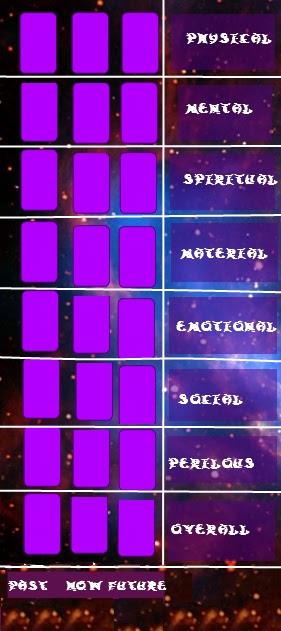
Sample Spread: The Eight Chambers Spread


This is a spread I call the Eight Chambers Spread. It deals with the past, present and future condition of eight different ares of the Querent's life:

1- Physical: The health and well being of the Querent.
2- Mental: The concerns, ideas and stability of the Querent.
3- Spiritual: Sources of faith and belief.
4- Material: Wealth, success, goals of the Querent.
5- Emotional: Sources of love and joy.
6- Social: The Querent's interactions, friends and family
7-Perilous: Obstacles, worries and challenges for the Querent.
8-Overall: A look at the general circumstances surrounding the Querent.

Friday, 22 July 2011

DIY Tarot

   If you want to really understand the essence of a card, and be sure that you will know its interpretation by heart, there is a way to give yourself a break from making lists, and endless hours of readings. Though these are essential, sometimes it pays to use your imagination. As mentioned here, you can utilise meditation and visualisation techniques, but if you feel like you want more of a hands on project, the best thing you can do is make your own!

   The process of designing your own cards will assist you in understanding them, each redesigned card challenging you to consider its deeper meaning. Don't be put off if you can't draw. neither can I! (as you can see below :P)


   Artistic talent or qualification need not be a factor when creating your own card or deck. There are other options, such as collage, and computer graphics. The whole point of this exercise is to develop a connection to the cards.

   It certainly worked for me. While it may seem corny or simplistic, redrawing strength as someone saving a life against their better nature helped me to really get to grips with its basic meaning. Likewise Justice - it was a challenge to try and convey both justice and injustice in a single card.

                             Try this next time you are 'stuck' on a card: consider how you would depict its meaning in a picture. Think of how you would explain 'The Tower' if you couldn't use words.

Numerology Pt. 2: What Does It All Mean? - The Birth Number


Last time, we learned about how to calculate birth, name, vowel and consonant numbers. So now let's take a closer look at each number, and the significances ascribed to them. We will begin with the birth number.

Significance

The birth number is also referred to as the destiny number, and is said to determine a person's basic character and general self. It is worth remembering that numbers prominent in the birthdate itself (e.g 6/6/62) are also important, and should be taken into consideration when compiling a profile. It is also said to be the person's lucky number, and to rule the most fortunate periods of that person's life. And here, as a very brief overview, is a beginners guide to the birth numbers:

One

Traditionally, those with a birth number of one - and those for whom the number one is significant in their birthdate - are daring, confident, enthusiastic people. They are said to bear all of the qualities typically associated with the Sun: power, determination, but also aggression. They do not back down from a challenge, and are natural leaders. They are great at inspiring those around them, and work hard to get what they want - though they may have a tendency toward extravagance. They are best suited to teaching, politics, government work and PR, and are well suited to a life of celebrity. It would also be unsurprising to find Ones in military service. They love being the center of attention, but can tend toward moodiness and occasional bouts of infantile behaviour.

Two

The number two is closely associated with the Moon, and as you'd expect, people with a birth number of two are said to be sensitive, and intuitive. Sleep does not come easy for the Twos of the world, as their anxieties often get the best of them. They lack confidence, and rarely feel in control of their lives. However, they are no pushover, and possess a gentleness and a quiet persistence that few others can match. They tend to be quite selfless, and may enjoy helping others over helping themselves. Twos make very good mediators and diplomats, and are often found working for charities and hospitals. They have vivid imaginations, and are attracted to the arts.

Three

Fun loving and exuberant, you know where you are with a three. People with a 3 birth number, or the number 3 prevalent in their birthdate, are kind, generous, outgoing and strongly moral. They bore easily, loving to move around from place to place, and will never flourish in a stable, steady job. Natural optimists, you will often find Threes tending to animals, and unionising the workforce! They are sociable, and love their food and drink. There is also a tendency toward frankness: never ask a 3 what they think unless you want the raw truth. This is not malicious - they are just naturally honest, and can even be pushy when they have to be.

Four

Fours are the reliable, slightly serious type. They have a good sense of humour, but rarely lose their composure - this can mask quite a dark, frustrated inner self, which you will soon see, should you push a Four too far. They tend to keep worries to themselves, and are honest, respectful people - although it can be rather difficult to get to know one. Their determination is a good quality, but also a flaw, as they do not always know when to give up. Fours are attracted to many different lines of work, but whatever they choose, they strive for perfection, and it is important to them to be the very best at what they do.

Five

Those with a birth number of five are said to be quick witted, intellectual, and natural conversationists. They are positively Mercurial in temperament, and enjoy any career that involves perception and self expression:law, writing, PR, advertising and journalism are quite common. Fives are very persuasive, even charming, but tire of things very quickly. Though generally cheerful, their tempers are quick, and they tend toward impatience. They love puzzles and logical challenges, and have a deep love of reading and learning.

Six

Sixes are said to choose their company quite carefully, as they cannot abide loud, rude and obnoxious people. They are happiest at home, and may enjoy artistic and musical pursuits. Sixes are said not to have many close friendships. Romance and domesticity are important to sixes, as is physical appearance - you will rarely see one ungroomed. They have an intense dislike of getting their hands dirty, and loathe manual labour. In fact, a Six is most suited to a well paid job with minimal responsibilities, for while they have a love of the material, they may not have the strongest work ethic.

Seven

Sevens are said to be dreamers and romantics. Others do not fully understand them, so they tend to prefer their own company, and their own ideas. They are very creative, but tend to lack specific direction, and may have many projects on the go at any one time. Sevens tend to have a natural gift for psychic work, and a caring disposition. They are gentle, friendly and caring, and make excellent, loyal friends.  They tend not to think or dress like other people, but have a deep sense of compasion toward their fellow man.

Eight

Those with a birth number of eight are traditionally believed to be introspective, and may have difficulty getting along with others. They have strong principles, but can be a little lacking in the humour department. Eights tend to mature early, and may even seem older than they really are. They are loners, and get on best with people older than themselves. They are typically the strong and silent type, and often know what their life goals are quite early on. Eights are attracted to long term jobs, as they seek security, and stability in a career tends to be very important to them.

Nine

Finally, those with a birth number of nine are said to be  outgoing, cougageous, and strong. They are hot blooded, and lose their cool very quickly. They very rarely plan ahead, which can be a source of some difficulty in their lives. Nines rarely sit on the fence, and tend to see things in black-and-whte terms.  Although they can be arrogant, and even domineering, they have an innate generosity which endears them quickly to others. Nines jump in with both feet, and their hearts are broken very easily. In fact, they rarely hold back in any situation.

Next: The Id and the Ego